
Standard Enthalpy of Neutralization (\( \Delta H_{\text{neut}}^\circ \))
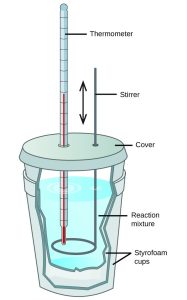
Title: Simple Calorimeter for Neutralization Experiments
Definition
The standard enthalpy of neutralization (\( \Delta H_{\text{neut}}^\circ \)) is the enthalpy change when one mole of water is formed from the reaction between an acid and a base under standard conditions.
Laboratory Experiment to Determine Enthalpy of Neutralization
Objective: To determine the enthalpy change when one mole of water is formed from the reaction between a strong acid and a strong base.
Apparatus:
- Polystyrene cup (calorimeter)
- Thermometer (\(0.1^\circ\text{C}\) precision)
- Measuring cylinder or volumetric pipette
- Stirring rod
Procedure:
- Measure \(50 \, \text{cm}^3\) of \(1.0 \, \text{mol/dm}^3\) hydrochloric acid (HCl) into the cup.
- Record the initial temperature.
- Measure \(50 \, \text{cm}^3\) of \(1.0 \, \text{mol/dm}^3\) sodium hydroxide (NaOH).
- Quickly add the NaOH solution to the acid.
- Stir gently and record the highest temperature reached.
- Repeat for consistent results.
Assumptions Made in the Experiment:
- Polystyrene cup is a good insulator (negligible heat loss).
- Specific heat capacity \(c = 4.18 \, \text{J g}^{-1} \, ^\circ\text{C}^{-1}\).
- Density ≈ \(1 \, \text{g/cm}^3\).
Calculation Steps
1. Temperature change (\( \Delta T \)):
\[ \Delta T = \text{Final temperature} – \text{Initial temperature} \]
2. Total mass of solution (\( m \)):
Volume of acid + volume of base (in grams)
3. Heat released (\( q \)):
\[ q = mc\Delta T \]
4. Moles of water formed:
Equal to moles of acid or base (1:1 reaction)
5. Enthalpy change per mole:
\[ \Delta H_{\text{neut}} = -\frac{q}{n} \]
Worked Example
Problem:
- \(50 \, \text{cm}^3\) of \(1.0 \, \text{mol/dm}^3\) HCl
- \(50 \, \text{cm}^3\) of \(1.0 \, \text{mol/dm}^3\) NaOH
- Initial temperature: \(25.0^\circ\text{C}\)
- Final temperature: \(31.8^\circ\text{C}\)
Solution:
Step 1: Temperature change
\[ \Delta T = 31.8 – 25.0 = 6.8^\circ\text{C} \]
Step 2: Mass of solution
\[ 100 \, \text{cm}^3 \Rightarrow 100 \, \text{g} \]
Step 3: Heat released
\[ q = 100 \times 4.18 \times 6.8 = 2842.4 \, \text{J} = 2.842 \, \text{kJ} \]
Step 4: Moles of water
\[ n = 1.0 \times 0.050 = 0.050 \, \text{mol} \]
Step 5: Enthalpy change
\[ \Delta H_{\text{neut}} = -\frac{2.842}{0.050} = -56.84 \, \text{kJ/mol} \]
Answer: \(-56.8 \, \text{kJ/mol}\)
Constant Value for Strong Acids and Bases
\[ \Delta H_{\text{neut}}^\circ \approx -57 \, \text{kJ/mol} \]
Why is this constant?
Strong acids and bases dissociate completely, so the same net ionic reaction always occurs:
\[ \text{H}^+(aq) + \text{OH}^-(aq) \rightarrow \text{H}_2\text{O}(l) \]
Thus, the enthalpy change remains approximately the same.
When the Value Differs
Strong Acid + Strong Base
ΔH: -57 kJ/mol
Complete dissociation; only \(H^+ + OH^- \rightarrow H_2O\)
Weak Acid + Strong Base
ΔH: Greater than -57 (less negative)
Energy absorbed to dissociate weak acid
Strong Acid + Weak Base
ΔH: Greater than -57 (less negative)
Energy absorbed to dissociate weak base
Key Points to Remember
1. State symbols are essential. When writing formation equations, ensure elements are shown in their standard states (e.g., H₂(g), C(graphite, s)).
2. “One mole” appears in most definitions. Pay attention to what quantity the enthalpy change is referenced to (e.g., per mole of compound, per mole of water).
3. Elements in standard states have ΔH_f° = 0. This is a defined reference point, not a measured value.
4. Strong acid + strong base neutralization is constant at -57 kJ/mol. If a weak acid or weak base is involved, the value will be different.
5. Formation and combustion are distinct. Formation builds a compound from elements; combustion burns a substance in oxygen. They are different processes with different definitions.
6. Experimental values may differ from theoretical values due to heat loss, incomplete reactions, and limitations of the apparatus.