
Standard Enthalpy of Combustion (\( \Delta H_c^\circ \))
Title: Bomb Calorimeter Used for Measuring Enthalpy of Combustion
Definition
The standard enthalpy of combustion (\( \Delta H_c^\circ \)) is the enthalpy change when one mole of a substance is completely burned in excess oxygen under standard conditions.
Laboratory Experiment to Determine Enthalpy of Combustion
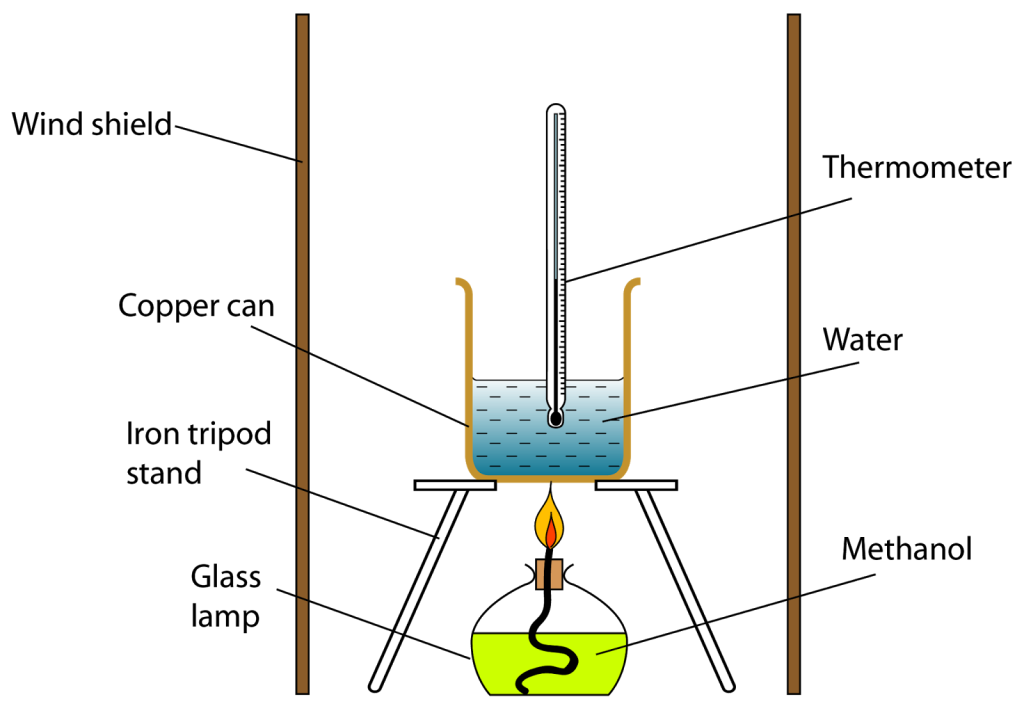
Objective: To determine the enthalpy change when one mole of a liquid fuel (e.g., ethanol) is completely burned. Apparatus:
- Copper calorimeter (or metal can)
- Spirit burner containing the liquid fuel
- Thermometer (\(0.1^\circ\text{C}\) precision)
- Measuring cylinder
- Stirrer
- Balance (accurate to \(0.01\text{ g}\))
- Clamp and stand
Procedure:
- Measure a known volume (e.g., \(100\text{ cm}^3\)) of water into the calorimeter (mass ≈ \(100\text{ g}\)).
- Record the initial temperature of the water.
- Weigh the spirit burner and record its initial mass.
- Place the burner under the calorimeter and light the wick.
- Stir continuously; when the temperature rises by \(10\text{–}15^\circ\text{C}\), extinguish the flame.
- Record the highest temperature reached and re-weigh the burner.
Assumptions:
- All heat released is absorbed by the water.
- Specific heat capacity of water: \(c = 4.18\text{ J g}^{-1}\,^\circ\text{C}^{-1}\).
- Combustion is complete.
Calculation Steps
1. Temperature change (\( \Delta T \)): \[ \Delta T = \text{Final temperature} – \text{Initial temperature} \] 2. Heat absorbed by water (\( q \)): \[ q = m \cdot c \cdot \Delta T \] 3. Moles of fuel burned (\( n \)): \[ n = \frac{\text{Mass of fuel burned}}{\text{Molar mass of fuel}} \] 4. Enthalpy change per mole: \[ \Delta H_c^\circ = -\frac{q}{n} \] (The negative sign indicates an exothermic reaction)
Worked Example
Problem:
- Water volume: \(150\text{ cm}^3\)
- \(\Delta T = 35.5^\circ\text{C} – 22.0^\circ\text{C} = 13.5^\circ\text{C}\)
- Mass of ethanol burned: \(0.92\text{ g}\)
- Molar mass of ethanol: \(46.0\text{ g/mol}\)
Solution: Step 1: Heat absorbed (\( q \)): \[ q = 150 \times 4.18 \times 13.5 = 8464.5\text{ J} = 8.4645\text{ kJ} \] Step 2: Moles of ethanol (\( n \)): \[ n = \frac{0.92}{46} = 0.020\text{ mol} \] Step 3: Enthalpy change (\( \Delta H_c^\circ \)): \[ \Delta H_c^\circ = -\frac{8.4645}{0.020} = -423.225\text{ kJ/mol} \] Answer: The enthalpy of combustion of ethanol is approximately \(-423\text{ kJ/mol}\).
Key Characteristics
- Always negative: Combustion reactions are exothermic.
- Complete combustion: Carbon \( \rightarrow CO_2(g) \), Hydrogen \( \rightarrow H_2O(l) \).
Examples
Methane
Formula: \(CH_4(g)\)
Combustion Equation:
\(CH_4(g) + 2O_2(g) \rightarrow CO_2(g) + 2H_2O(l)\)
\( \Delta H_c^\circ \): -890 kJ/mol
Ethanol
Formula: \(C_2H_5OH(l)\)
Combustion Equation:
\(C_2H_5OH(l) + 3O_2(g) \rightarrow 2CO_2(g) + 3H_2O(l)\)
\( \Delta H_c^\circ \): -1367 kJ/mol
Hydrogen
Formula: \(H_2(g)\)
Combustion Equation:
\(H_2(g) + \frac{1}{2}O_2(g) \rightarrow H_2O(l)\)
\( \Delta H_c^\circ \): -286 kJ/mol