
Calorimetry
Introduction to Calorimetry
Calorimetry is the experimental technique used to measure the heat transferred during a physical or chemical process. The device used for this measurement is called a calorimeter. The principle behind calorimetry is the law of conservation of energy: the heat released by a system is equal to the heat absorbed by the surroundings (and vice versa).
Basic Principle
\[ q_{\text{system}} + q_{\text{surroundings}} = 0 \]
or simply:
\[ q_{\text{reaction}} = -q_{\text{calorimeter}} \]
The heat absorbed by the calorimeter and its contents is calculated using:
\[ q = mc\Delta T \]
Where:
- \( q \) = heat absorbed or released (J or kJ)
- \( m \) = mass of the substance (g)
- \( c \) = specific heat capacity (J g⁻¹ °C⁻¹)
- \( \Delta T \) = change in temperature (°C or K)
Simple Calorimeter (Polystyrene Cup Calorimeter)
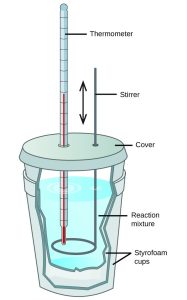
Title: Simple Polystyrene Cup Calorimeter
Uses: Suitable for measuring enthalpy changes in aqueous solutions, such as neutralization reactions, dissolution processes, and displacement reactions.
Construction:
- A polystyrene cup (acts as an insulator)
- A lid with a hole for the thermometer
- A thermometer (0.1°C precision)
- A stirring rod
Advantages:
- Inexpensive and disposable
- Good insulation properties
- Quick to set up
Limitations:
- Not suitable for reactions involving gases
- Some heat loss to surroundings occurs despite insulation
- Cannot measure combustion reactions
Experimental Procedure (Neutralization):
- Measure a known volume of acid into the polystyrene cup.
- Record the initial temperature.
- Measure a known volume of base.
- Add the base to the acid, stir, and record the highest temperature reached.
- Calculate the heat released and the enthalpy change per mole.
Worked Example:
Problem: 50 cm³ of 0.5 mol/dm³ HCl at 24.0°C was mixed with 50 cm³ of 0.5 mol/dm³ NaOH at 24.0°C in a polystyrene cup. The maximum temperature reached was 27.3°C. Calculate the enthalpy of neutralization. (Specific heat capacity of solution = 4.18 J g⁻¹ °C⁻¹, density = 1.0 g/cm³)
Solution:
\[ \Delta T = 27.3 – 24.0 = 3.3^\circ C \]
\[ m = 100 \, \text{cm}^3 \times 1.0 \, \text{g/cm}^3 = 100 \, \text{g} \]
\[ q = mc\Delta T = 100 \times 4.18 \times 3.3 = 1379.4 \, \text{J} = 1.3794 \, \text{kJ} \]
\[ n = 0.5 \, \text{mol/dm}^3 \times 0.050 \, \text{dm}^3 = 0.025 \, \text{mol} \]
\[ \Delta H_{\text{neut}} = -\frac{1.3794}{0.025} = -55.18 \, \text{kJ/mol} \]
Bomb Calorimeter
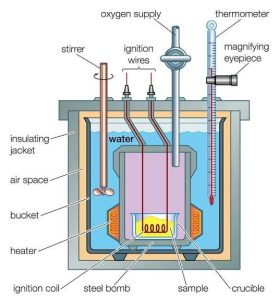
Title: Bomb Calorimeter for Combustion Reactions
Uses: Specifically designed to measure the enthalpy of combustion of substances, particularly solids and liquids.
Construction:
- A strong stainless steel container (the “bomb”) that can withstand high pressure
- An ignition system with electrical wires
- A known mass of water surrounding the bomb
- A thermometer (often a digital thermistor with high precision)
- An insulated jacket to minimize heat loss
Procedure:
- A precise mass of the sample is placed in a crucible inside the bomb.
- The bomb is sealed and filled with pure oxygen at high pressure (about 25–30 atm).
- The bomb is placed in the calorimeter containing a known mass of water.
- The initial temperature of the water is recorded.
- The sample is ignited electrically.
- The temperature rise is recorded until a maximum is reached.
- The heat released is calculated using the heat capacity of the calorimeter system.
Calibration:
Bomb calorimeters are calibrated using a substance with a known enthalpy of combustion, such as benzoic acid (ΔH_c° = -3227 kJ/mol). The heat capacity of the calorimeter (C_cal) is determined using:
\[ q_{\text{combustion}} = -C_{\text{cal}} \times \Delta T \]
Worked Example:
Problem: A bomb calorimeter has a heat capacity of 10.2 kJ/°C. When 0.50 g of ethanol (C₂H₅OH) was burned, the temperature of the calorimeter increased from 22.0°C to 24.5°C. Calculate the enthalpy of combustion of ethanol per mole. (Molar mass of ethanol = 46.0 g/mol)
Solution:
\[ \Delta T = 24.5 – 22.0 = 2.5^\circ C \]
\[ q_{\text{calorimeter}} = C_{\text{cal}} \times \Delta T = 10.2 \, \text{kJ/°C} \times 2.5^\circ C = 25.5 \, \text{kJ} \]
\[ q_{\text{combustion}} = -25.5 \, \text{kJ} \quad (\text{heat released by the reaction}) \]
\[ n_{\text{ethanol}} = \frac{0.50 \, \text{g}}{46.0 \, \text{g/mol}} = 0.01087 \, \text{mol} \]
\[ \Delta H_c^\circ = -\frac{25.5}{0.01087} = -2346 \, \text{kJ/mol} \]
Note: This value differs from the theoretical value (-1367 kJ/mol) because the example uses simplified numbers. In practice, calibration ensures accuracy.
Comparison of Calorimeters
Simple Calorimeter
Feature: Simple Calorimeter
Pressure: Constant pressure (atmospheric)
Measured Quantity: ΔH (enthalpy change)
Typical Uses: Neutralization, dissolution, displacement
Insulation: Polystyrene cup
Accuracy: Moderate (some heat loss)
Cost: Low
Bomb Calorimeter
Feature: Bomb Calorimeter
Pressure: Constant volume
Measured Quantity: ΔU (internal energy change), then converted to ΔH
Typical Uses: Combustion reactions
Insulation: Insulated jacket with water jacket
Accuracy: High (calibrated system)
Cost: High
Relationship between ΔH and ΔU:
\[ \Delta H = \Delta U + \Delta n_g RT \]
Where:
- \( \Delta n_g \) = change in moles of gas (moles of gaseous products – moles of gaseous reactants)
- \( R = 8.314 \, \text{J mol}^{-1} \text{K}^{-1} \)
- \( T \) = temperature in Kelvin
For reactions involving only solids and liquids,
\[ \Delta H \approx \Delta U \]