
Course Content
Module 1: Fundamental Concepts of Energy
Welcome to the world of chemical energy! Before we can understand how reactions absorb or release heat, we need to establish a common language. In this foundational module, you will be introduced to the key players: the system (the reaction we care about) and the surroundings (everything else). You will learn the critical difference between heat and temperature and be introduced to Enthalpy (H) , the measure of total heat content in a system. By the end of this module, you will understand that in chemistry, we never measure absolute heat—only changes in heat (ΔH) . This concept is the gateway to everything that follows in the course.
0/4
Exothermic and Endothermic Reactions
Have you ever touched a beaker after a reaction and felt it burn your hand, or noticed it turn icy cold? That is thermochemistry in action! This module dives into the two major classes of energy change. You will learn to identify exothermic reactions (ΔH negative) that release heat, like combustion and neutralization, and endothermic reactions (ΔH positive) that absorb heat, like photosynthesis. More importantly, you will learn to draw and interpret energy profile diagrams—a favorite WAEC and JAMB question. These diagrams visually show the energy "hill" that reactions must climb, introducing the concept of Activation Energy (Ea) .
0/4
Enthalpy Changes of Physical Changes and Chemical Reactions
This is where we get precise. WAEC and JAMB love to test specific definitions. In this module, you will learn the exact language required to score full marks. We will dissect the Standard Enthalpy of Formation (ΔH_f°) —the most important reference point for all energy calculations—and discover why the value for every element in its standard state is zero. You will also master the Enthalpy of Combustion (ΔH_c°) and the constant value associated with the Enthalpy of Neutralization (ΔH_neut) for strong acids and bases. Memorizing these definitions is essential, but understanding them is even more critical.
0/7
Hess’s Law (The Law of Constant Heat Summation)
What if a reaction is too slow, too dangerous, or too difficult to measure in a lab? How do we find its enthalpy change? Enter Hess's Law, one of the most elegant and powerful tools in chemistry. This module teaches you that enthalpy is a "state function"—meaning the path taken from reactants to products doesn't matter; only the start and end points count. You will learn two methods to apply Hess's Law: the algebraic method (manipulating equations) and the energy cycle method (using formation or combustion data). While this is often considered the most challenging topic in thermochemistry, mastering it guarantees you can solve virtually any enthalpy problem thrown at you.
0/4
Bond Enthalpies
Chemical reactions involve breaking old bonds and forming new ones. This module looks at energy from the perspective of these bonds. You will learn about mean bond enthalpy—the average energy required to break a specific type of bond. This allows us to estimate the enthalpy change of a reaction using a simple concept: energy must be supplied to break bonds (endothermic), and energy is released when bonds form (exothermic). The formula ΔH = Σ(Bonds Broken) – Σ(Bonds Formed) will become your new best friend. While this method provides an estimate rather than an exact value, it is a quick and useful tool, especially for gaseous reactions. Module 8: Exam-Focused Revision and Problem Solving
0/2
Thermochemistry I

Energy Profile Diagrams

Chemists use Energy Profile Diagrams (also called Reaction Coordinate Diagrams) to visualize the energy changes during a reaction. They plot the potential energy of the molecules on the vertical axis (y-axis) against the progress of the reaction on the horizontal axis (x-axis).

Key Features to Label on ALL Diagrams:
  • Reactants: The energy level at the start of the reaction.
  • Products: The energy level at the end of the reaction.
  • Activation Energy (Ea): The minimum amount of energy required for the reactants to successfully collide and transform into products. It is the “energy barrier” that must be overcome. Represented by the “hill” from the reactants to the peak of the curve.
  • Enthalpy Change (ΔH): The overall difference in energy between the products and the reactants. Calculated as ΔH = H(products) – H(reactants) .
  • Transition State: The highest point on the diagram, representing an unstable, high-energy state where bonds are partially broken and formed.
Diagram 1: Energy Profile Diagram for an Exothermic Reaction
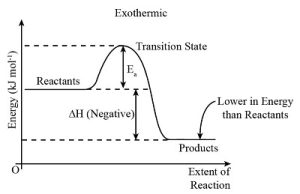
  • Shape: The curve starts at the reactants, goes up to the peak (Ea), and then descends to a lower energy level for the products.
  • Reactants: Located at a relatively high energy level.
  • Products: Located at a relatively low energy level.
  • ΔH: The arrow pointing downwards from reactants to products. It is a negative value.

Visual Check: The products are lower on the y-axis than the reactants.

Diagram 2: Energy Profile Diagram for an Endothermic Reaction
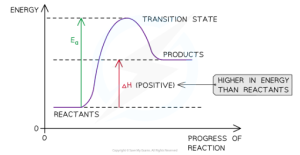
  • Shape: The curve starts at the reactants, goes up to the peak (Ea), and then descends slightly, but finishes at a higher energy level than where it started.
  • Reactants: Located at a relatively low energy level.
  • Products: Located at a relatively high energy level.
  • ΔH: The arrow pointing upwards from reactants to products. It is a positive value.

Visual Check: The products are higher on the y-axis than the reactants.