
Course Content
Module 1: Foundations of Redox Reactions
Oxidation and Reduction: Understanding redox in terms of oxygen transfer, hydrogen transfer, and electron transfer. Oxidation Numbers: Rules for assigning oxidation states and identifying oxidizing/reducing agents. Balancing Redox Equations: Half-reaction method and oxidation number method.
0/5
Module 2: Electrolysis (The Electrolytic Cell)
Components of Electrolysis: Electrolytes (strong vs. weak), electrodes (inert vs. active), and the electrolytic tank. Preferential Discharge of Ions: Factors affecting the discharge of ions (position in electrochemical series, concentration, and nature of electrodes). Practical Examples: Electrolysis of acidified water, brine, and copper(II) sulfate solution.
0/3
Module 3: Quantitative Electrochemistry (Faraday’s Laws)
Module 3: Quantitative Electrochemistry (Faraday’s Laws)Faraday’s First Law: Relationship between mass ($m$), current ($I$), and time ($t$). Formula: $m = zIt$.Faraday’s Second Law: Chemical equivalents and the Faraday constant ($96,500 text{ C mol}^{-1}$).Calculations: Determining mass deposited, volume of gases at STP, and the charge on ions.
Module 4: Electrochemical Cells (Galvanic/Voltaic)
Cell Construction: Half-cells, salt bridges, and external circuits. Standard Electrode Potential (E ∘ ): The Standard Hydrogen Electrode (SHE) and the Electrochemical Series. Cell Notation: Writing and interpreting cell diagrams (e.g., Zn (s)∣Zn(aq)2+ ∣∣Cu (aq)2+ ∣Cu (s)). Electromotive Force (e.m.f.): Calculating E cell ∘ ​ =E cathode ∘ ​ −E anode
Module 5: Industrial Applications & Corrosion
Electroplating and Purification: How electrolysis is used to coat metals and refine copper. Primary and Secondary Cells: Lead-acid accumulators, dry cells (Leclanché), and fuel cells. Corrosion of Metals: The chemistry of rusting and methods of prevention (cathodic protection, galvanizing).
Module 6: Exam Prep (WAEC/NECO/UTME Focus)
Electrochemistry

Module 2: Electrolysis (The Electrolytic Cell)

In Module 1, we learned that redox reactions involve the transfer of electrons. In a galvanic (voltaic) cell, this transfer happens spontaneously and generates electrical energy. In an electrolytic cell, we do the opposite: we supply electrical energy to drive a non-spontaneous redox reaction. This process is called electrolysis.
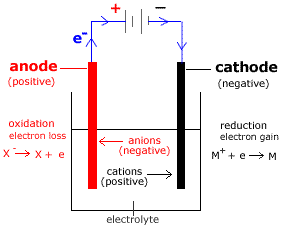

1. Components of an Electrolytic Cell

Every electrolytic cell consists of four essential parts:

Power Supply (Battery)

Provides the direct current (DC) that forces electrons to move.

Note: Positive terminal → anode; Negative terminal → cathode.

Electrolyte

An ionic compound (molten or in solution) that conducts electricity.

Ions move toward the electrodes during electrolysis.

Electrodes

Conducting rods (often metal or graphite) that allow electrons to enter or leave the electrolyte.

Electrolytic Tank

An inert vessel that holds the electrolyte and electrodes.

Usually open or designed to allow collection of gases.


1.1 Electrolytes: Strong vs. Weak

Strong Electrolyte

Dissociates completely into ions in solution.

Examples: \( NaCl \), \( H_2SO_4 \), \( KOH \)

Effect: Allows a large current to flow.

Weak Electrolyte

Dissociates only partially in solution.

Examples: Acetic acid, ammonia solution

Effect: Conducts electricity poorly.

Important: In electrolysis, strong electrolytes are usually used to ensure sufficient ion movement.


1.2 Electrodes: Inert vs. Active

Inert Electrodes

Examples: Platinum (\(Pt\)), graphite (carbon)

Behavior: Do not participate chemically; they only provide a surface for electron transfer.

Active Electrodes

Examples: Copper, silver, nickel

Behavior: Can be oxidized or reduced during electrolysis.

Commonly used in electroplating and refining.

The choice of electrode material significantly affects which reactions occur at the surface.